Original research project / in development
Reachy
and EBO.
Two identities.
One shared world.
Memory, goals and learning from experience.
My own research, from OUTSIDE to Reachy.
How it works
Event and source
I am developing a digital housemate with its own memory, goals, changing state, learning, and relationships. In Reachy, I develop mechanisms created in my original OUTSIDE project, combining them with conversation and everyday activity. EBO is a separate partner with its own identity, history, and decisions.
History and scope of the work
OUTSIDE: my own project, the foundation for Reachy
OUTSIDE is my original research project, which I built from scratch around one question: how can I create a system that maintains continuity between conversations and changes its behavior based on experience? In it, I designed and developed memory, attention, uncertainty, predictions, and self-improvement. In Reachy, I am developing selected mechanisms that emerged from this work: algorithms for action selection, habituation, memory availability, homeostasis, goals, learning measurement, evidence evaluation, belief review, and recognition of its own capabilities. I combine this work with conversation, an internal state, and the relationships of a digital housemate. OUTSIDE and Reachy are successive stages of my research into memory, decisions, and learning.
One Self, many ways to connect
Memory, identity, current state, decisions, and their outcomes are connected by one persistent core, called the Self in the project. Text conversation, voice, and a robot’s future expression all use the same core. A language model is one of its tools. I built persistent storage in SQLite and an event log so that a restart, a session change, or a response-provider failure does not restart the entire history from zero. An event, the decision made, and the confirmed result are stored separately, making it possible to trace what actually happened.
Memory that also remembers its source
A direct observation, a person’s account, a model summary, and an EBO message have different meanings. I developed fact storage with provenance, freshness assessment, and uncertainty. Conflicting information remains unresolved until it can be clarified, and repetition from the same source does not become a second independent confirmation. Memory also includes the availability of recollections and a review of aging beliefs: an old record does not always have to enter the current conversation. A correction should change future behavior while preserving the history of where the earlier belief came from.
Attention and initiative: sometimes silence is best
Reachy chooses among possible actions by considering their relevance, expected benefit, cost, and current context. Quiet observation and leaving a person alone are also among the candidates. The habituation mechanism I developed in OUTSIDE weakens the response to a repetitive signal with little novelty; fresh information can attract attention again. Frequency limits, intervals between initiatives, and quiet hours add further constraints. The reason for a chosen action or for silence is recorded, allowing me to study the decision instead of inferring it from a generated statement.
Homeostasis and goals: internal state affects the choice
The homeostasis developed in OUTSIDE organizes internal tensions and needs based on signals from the system itself. Goals use the history of individual types of initiative and their expected progress. As a result, the choice of action can follow from the current state and experience rather than solely from the latest message. I connected these mechanisms with the Reachy layer responsible for initiative and outcome measurement. I am studying whether the system can choose the right moment and type of action while maintaining boundaries around privacy, cost, and a person’s attention.
Learning from experience, including refusal
I built a cycle of hypothesis, action, observed response, update, and later verification. Experiences are linked to a specific person, type of initiative, and time of day. An explicit refusal matters for future suggestions; the mechanism can set a hypothesis aside and return to it later. A lack of response alone remains ambiguous–a person may not have heard or may have been busy. A separate layer records the predicted outcome and compares it with the confirmed result. Learning is based on this comparison, distinguishing delivery, response, and usefulness.
Its own capability model and a decision trail
Reachy has a capability registry that accounts for configuration, data freshness, and recent successes and failures. It distinguishes between available, limited, and unavailable capabilities; the mere presence of a module in the code is not enough to promise that it works. I also added a causal trail for initiatives: the observation, motive, alternatives considered, expected effect, and actual result. This record makes it possible to see why the system chose something and how experience influenced the next decision. It is an important part of studying the reliability of its own account.
State, character, and emotions with a cause
The project includes a more slowly changing character and shorter emotional states, with intensity, duration, and a linked event. Traits such as curiosity, caution, or talkativeness affect initiative parameters and conversational context. Changes are bounded and arise from recorded experiences; a day without measurements should not alter character by itself. State persists between runs. In this way, I study the coherence and development of a digital housemate’s behavior. Emotion names describe system mechanisms without settling the question of consciousness.
The surrounding world: context instead of confident guesses
I developed a model of the current environment derived from the event log: presence, recent conversations, changes, and more important matters. Every statement should lead to a specific source, while an assumption should remain an assumption. This also applies to identifying people and judging whether a statement was addressed to Reachy. An unknown addressee or the absence of a fresh observation must not be replaced by a confident answer. Context helps select behavior, while separate privacy rules limit retained content and the range of available senses.
Conversation, voice, and continuity during failures
The work covers detecting speech, transcription, assessing the addressee, composing a response, and playing it back. I am developing cooperation between model providers and a local path, with a return after service availability is confirmed. Losing one channel should not erase the housemate’s memory. I separated the intent to speak, acceptance for execution, and actual playback: each stage provides different evidence. Voice quality, microphone operation, and speech understanding on the physical device still require their own trials, independently of tests of the other parts of the software.
Self-improvement: measurement, trial, and reversibility
The project includes a self-improvement workshop based on measurable outcomes. The system can select bounded parameter changes, assess a trial period, and reverse a change when the result deteriorates. For code development, I prepared a separate cycle: hypothesis, an isolated copy of the source, scope control, tests, and activation of a verified version by a supervisor. Private memory and keys do not enter the experiment environment. The starting version and trial result are recorded, allowing the previous state to be recovered. Merely running a new version does not yet prove a long-term improvement in behavior–that must be measured.
EBO: reverse engineering and my own integration
Work on EBO also included reverse engineering: analyzing device communication, packet formats, image and audio streams, and the way commands are transmitted. I prepared an offline packet analyzer and developed my own adapters connecting the robot to the housemate system. I built a continuous image receiver that monitors frame freshness; I also improved concurrent-read handling so that subsequent requests do not lose a valid image. I studied audio-frame formats, telemetry, and control-channel behavior. I create EBO’s conversation, memory, goals, decisions, and relationship with Reachy in my own software. This layer makes it possible to develop the housemate’s behavior independently of the ready-made functions in the manufacturer’s app.
Reachy and EBO: a relationship between two independent partners
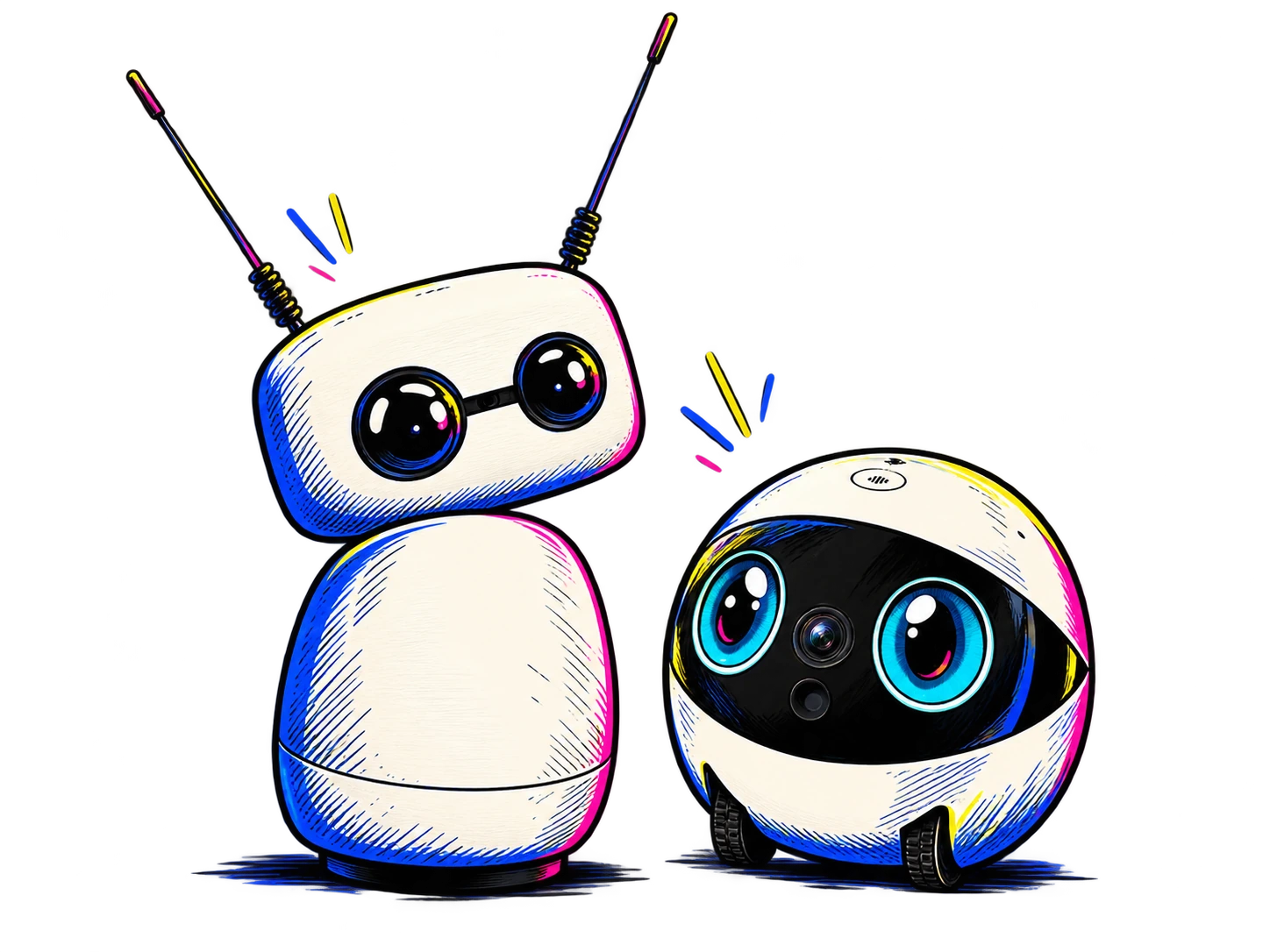
Adding EBO introduced a second identity with its own state, goals, and private history. Reachy and EBO can exchange messages, initiate contact, cooperate, or refuse. The relationship develops separately on both sides through experience; it is not reduced to a conversation counter. I prepared separate memories, persistent mailboxes, and redelivery control. A partner’s message retains its provenance as that partner’s account, while sharing context does not mean sharing the entire private history. Limits on initiative and successive replies prevent conversations from looping.
Expression and contact with the environment
I am developing a layer that connects the digital housemate’s decisions with expression and contact with the environment. The Reachy Mini simulator supports work on motion and ways of expressing state. EBO Air 2 Plus integration includes a communication bridge and trials of image, sound, short drives, stopping, and charging. I am studying how conversation, memory, and decisions can work with these channels in one coherent experience.
What is mine in this work and what I am still studying
My work includes building OUTSIDE from scratch, developing its mechanisms in Reachy, the architecture of the digital housemate, data persistence, memory and decision rules, learning, relationships, EBO reverse engineering, and my own integration layer for the device and its channels of contact. The Reachy Mini and EBO hardware were created by their manufacturers. I develop regression tests, failure scenarios, diagnostics, and controlled versions while preserving the distinction between code, execution, and an actual result. The next questions concern long-term continuity, reliable learning, the quality of voice contact, and physical cooperation. This remains an open research project, progressing from experiences with OUTSIDE toward everyday presence and relationship.
What this work makes possible
The project combines memory, internal state, goals, decisions, and learning into one continuous history. It teaches me to build systems in which the path from information to action can be traced and whether the result actually occurred can be verified.
A research project in development. The portfolio presents its architecture and the scope of my work; private conversations, images from the home, and device control remain outside the site.